Pass the Chutney, Watch for Soucouyant and Beware Unclean Hands

“Don’t accept no food from Mr. Ramkisoon. Neighbor say Mr. Ramkisoon hands not clean.” The names have been changed to protect the accused, but this was the warning given by my parents before I got on a plane bound for our house in Trinidad. For those who might not be aware of the phraseology, the concern about Mr. Ramkisoon’s unclean hands has nothing to do with his hygiene. It was a warning that Mr. Ramkisoon possibly dabbled in some “simi dimi,” or more likely had done something foul to earn a curse placed upon him. My parents (who now live in the US) had it on good information–an Indian neighbor on our block who kept them apprised of the goings on back home. Like the song say, “Trini talk talk talk talk talk…”

So here were my Afro-Trinidadian parents, who are nominally Christian, concerned with superstitions rooted in Hindu (specifically Indian-Trinidadian) folklore. Welcome to the cultural mash-up of my childhood, or as I like to call it, a little bit chutney and a little bit pelau.

Continue reading →

300 Spartans, 1 Million Persians and the Altering of History

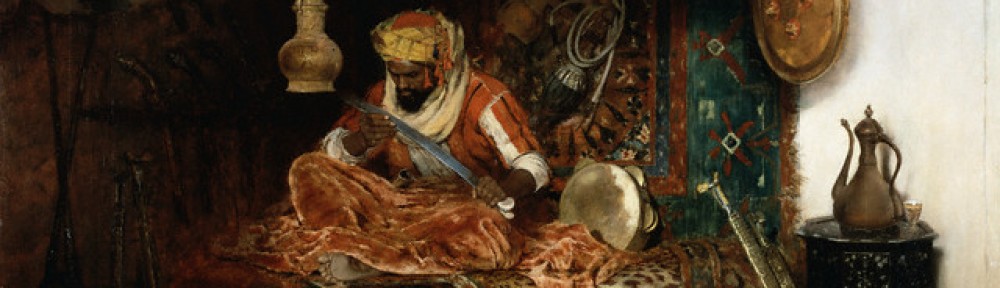
So I’m doing what I normally do when I should be working/writing (trying to read the entire internet) and quite by chance I find out they’re making a sequel to 300. Then I threw up in my mouth a little… because nothing makes me gag like the thought of another bit of Hollywood-formulated Occidental fantasy and Orientalist othering with a large dose of historical revisionism by that icon of multiculturalism and gender representation, Frank Miller. Re-posted below, for whoever cares, is a review and critique I wrote on 300 back in 2007. In the name of blogger honesty, I haven’t changed anything from the original post–except for a few broken links. I have a feeling the inevitable sequel won’t require me to do that much revision anyway.

Continue reading →

He Has Excited Domestic Insurrections Amongst Us: American Slavery on the 4th of July

“He has excited domestic insurrections amongst us, and has endeavoured to bring on the inhabitants of our frontiers, the merciless Indian Savages, whose known rule of warfare, is an undistinguished destruction of all ages, sexes and conditions.”–Thomas Jefferson, Declaration of Independence July 4, 1776.

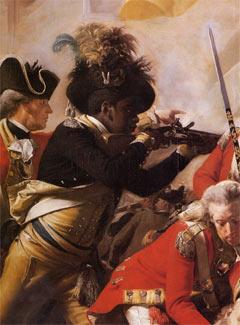
That peculiar passage in the Declaration of Independence always drew me when I was younger. I found it disconcerting that a document in which white men were listing their grievances against an English king they saw as despotic, they at the same time could make such disparaging comments about the indigenous population whose lands they now held. It was one of my first understandings of the great American paradox of liberty and freedom. But it was not until I was much older that I understood the first part: “He has excited domestic insurrection amongst us.” Who had the king of England “excited?” What “domestic” rebellion did Jefferson and the colonists so fear could erupt in their midst? It turned out that my earlier history classes had omitted something from the American Revolution, key players whose significance was enough to warrant mention and concern in the fledgling nation’s premiere document–slaves.

This isn’t alternate history.

Continue reading →

He Has Excited Domestic Insurrections Amongst Us: American Slavery on the 4th of July

“He has excited domestic insurrections amongst us, and has endeavoured to bring on the inhabitants of our frontiers, the merciless Indian Savages, whose known rule of warfare, is an undistinguished destruction of all ages, sexes and conditions.”–Thomas Jefferson, Declaration of Independence July 4, 1776.

That peculiar passage in the Declaration of Independence always drew me when I was younger. I found it disconcerting that a document in which white men were listing their grievances against an English king they saw as despotic, they at the same time could make such disparaging comments about the indigenous population whose lands they now held. It was one of my first understandings of the great American paradox of liberty and freedom. But it was not until I was much older that I understood the first part: “He has excited domestic insurrection amongst us.” Who had the king of England “excited?” What “domestic” rebellion did Jefferson and the colonists so fear could erupt in their midst? It turned out that my earlier history classes had omitted something from the American Revolution, key players whose significance was enough to warrant mention and concern in the fledgling nation’s premiere document–slaves.

This isn’t alternate history.

Continue reading →

Frederick Douglass: Zombie Killer or Why Let Lincoln Have all the Fun?

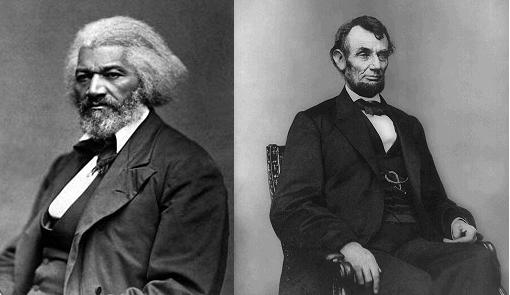
“I’m sick of these m@thaf*ckin zombies on this m@thaf*ckin train!” utters Frederick Douglass, right before he begins slaying hordes of the undead with a shotgun and sword. Remember that part in history class? When Frederick Douglass slayed all those zombies? On a train? No? Good. Thank a public school teacher. The lines are actually part of a spoof trailer created by Ola Betiku, mocking the film adaptation of Seth Grahame-Smith’s minorly steampunk but majorly alternate-history monster feature Abraham Lincoln: Vampire Hunter due out in theaters this weekend.

Continue reading →