Steampunk Ida B. Wells-Barnett: Anti-Lynching, Anti-Victorian Crusader

“One had better die fighting against injustice than die like a dog or a rat in a trap.” – Ida B. Wells-Barnett

At a recent history conference, I had the fortune of attending a plenary titled “Mightier than the Sword: Conversations on the Life and Legacy of Ida B. Wells-Barnett.” The panel featured historians Mia Bay, Paula Giddings and Patricia Schechter (among others), all of whom have authored works on the famed anti-lynching crusader. Though I’d studied Ida B. Wells-Barnett previously, during the discussion I was once again struck by her intense radicalism, which ran counter to the sensibilities of gender, activism and racial justice that pervaded the times. As often happens, my historian’s mind wandered into the speculative–particularly steampunk, where the Victorian Age’s analogous twin across the Atlantic, what Mark Twain satirized as “The Gilded Age” and well into the later “Progressive Era,” carried a violent dark side that Ida B. Wells-Barnett dedicated her life to revealing.

Continue reading

Robert A. Heinlein- Letter from the Dean

“Nor do I feel responsible for the generally low state of the Negro—as one Negro friend pointed out to me; the lucky Negroes were the ones who were enslaved. Having traveled quite a bit in Africa, I know what she means. One thing is clear: Whether one speaks of technology or social institutions, “civilization” was invented by us, not by the Negroes. As races, as cultures, we are five thousand years, about, ahead of them. Except for the culture, both institutions and technology, that they got from us, they would still be in the stone age, along with its slavery, cannibalism, tyranny, and utter lack of the concept we call “justice.”–Robert Heinlein

Well at least he didn’t use the n-word…

Continue reading

Always Chaotic Evil- Confronting My Anti-Orc Bias

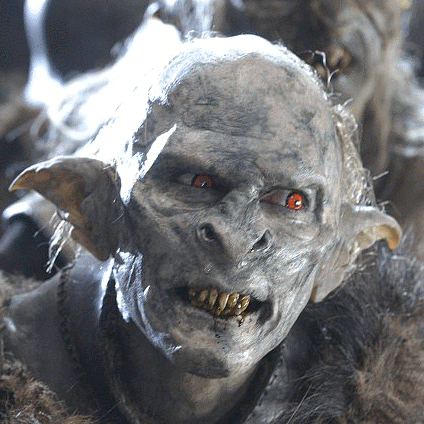
I’m a fantasy racist. There I admit it. It’s not entirely my fault. It’s what I was taught. From an early age, my fantasy godfathers and godmothers (well, mostly fathers actually), raised me to despise Goblins, Orcs, Trollocs and a host of other sub-human beings who tend to congregate in throngs, masses and “teeming hordes.” Let’s face it, when was the last time you met a “horde” that was “teeming” with good intentions? Right. I thought so. Vicious, mindless, perverse, prone to mayhem, pillaging and not above stewing other sentient beings in a cooking pot, I came to learn that there were precious few worthy qualities about any of them. The only good Orc is a dead Orc! Right….?

Continue reading

Black People on Mars: Race and Ray Bradbury

Prolific science fiction writer Ray Bradbury died this week, at the age of 91. I read my first Bradbury book in middle school–The Illustrated Man— and it *blew my mind.* It wasn’t my first speculative fiction book by any means. I’d long torn through Middle Earth, traveled Narnia, tesseracted across space and time with Meg and Charles Wallace and tried my hand at inventing with Danny Dunn. (Yeah, let those memories sink in). But the stories in The Illustrated Man were on another level–it was like everything I loved about the old Rod Serling hostedTwilight Zone episodes my mother got me into, but on paper…and with words! From the creepy virtual reality nursery story “The Veldt” to the hauntingly sad “The Exiles” (we made Santa cry!) to every-kid’s-revenge story “Zero Hour,” I knew I’d never look at sci-fi the same way again. Most startling of all was a story by Bradbury called “The Other Foot”–startling to my young PoC eyes, because the main characters were something I’d hardly seen before. They were black.

Continue reading

Hunger Games

Finally saw Hunger Games last week, or as I like to call it Lord of the Flies meets Soylent Green. Basic storyline: in a dystopian future, following a fracticious war that almost destroyed humanity, the world is divided into the wealthy victors, and the downtrodden nearly-starved rebels, who are forced to live in impoverished districts according to their usually dangerous occupations (coal miners, etc); as macabre sport and psychological punishment, every year each district is forced to participate in a lottery where two children are selected at random to participate in a survivalist, winner-kill-all, spectator contest called The Hunger Games. I haven’t read Suzanne Collins books, though I’ve been “meaning to get around to it.”

Continue reading